
InventoryReconOG Product Brochure
Reconciliation across depot operations and finance
- Tank stock vs SAP book stock
- Authorised adjustment decisions
- Traceable outcome in SAP
Tank stock reconciliation with accountable closure
A stock variance needs an explanation, an authorised decision and a traceable outcome in SAP.
InventoryReconOG.AI is Splisys’ proposed reconciliation application for downstream Oil & Gas. It brings the comparison of tank stock and SAP book stock into a working process for the people who investigate differences, approve adjustments and confirm completion.
The starting point is a familiar depot activity. Receipts, issues and transfers change the expected stock position. Tank readings provide the physical position. A difference between them can require a timing check, a measurement review or a genuine gain or loss adjustment. The application is designed to keep that work connected.
The customer need
When reconciliation information travels through separate extracts, spreadsheets and messages, the person approving an adjustment may have to reconstruct its context. The finance team may see a variance without knowing whether operations has reviewed it or whether posting has succeeded. InventoryReconOG addresses this handover through a dedicated reconciliation workspace.
| Business activity | Focus of the application |
|---|---|
| Daily operational review | Compare stock and investigate discrepancies while the relevant movements are still recent. |
| Approval of an adjustment | Apply the agreed delegation of authority and preserve the decision context. |
| Period-end reconciliation | Review outstanding items and verify the agreed book-stock adjustment process. |
Intended users
Depot and terminal operators prepare the reconciliation. Designated managers review adjustments. Finance checks completion and the resulting stock records. SAP teams establish the integration and operating controls.
This brochure describes the documented product approach. Final release scope and customer fit are confirmed before implementation.
Stock comparison in its operational context
The reconciliation begins with a defined plant, storage location and date. Book stock and physical measurements must describe the same stock point and cut-off. A consistent unit and reference-temperature basis are prerequisites for a meaningful comparison.
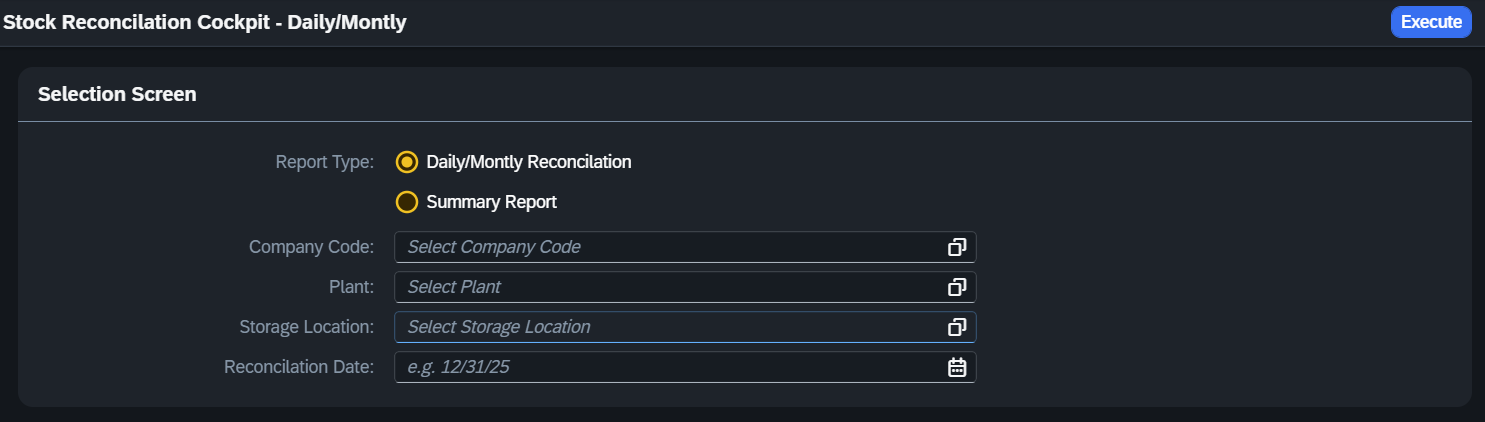
Book stock and physical measurements
The documented calculation uses opening stock and relevant receipts and issues to establish the expected closing position. Transfers and other movements must enter the calculation with the correct sign. Physical stock comes from the customer’s tank-dip process, including automatic readings or an approved manual record.
The functional design uses quantities at a reference temperature of 15 °C. The implementation must confirm the conversion responsibility, tank mapping, cut-off and source-reading selection. A result cannot be more reliable than the measurement and movement data supporting it.
What the user needs to see
A useful comparison shows the opening balance, movement quantities, closing book stock, physical stock and residual difference. The documented screens also provide access to material-document information, helping the user relate a variance to the underlying SAP movements.
Screens are supplied drafts. Labels and layout may change in the validated release.
Investigation and approval
The reconciliation record should explain what is being adjusted and who has authorised it.
InventoryReconOG’s source design includes tolerance checking and approval routing. The proposed workflow gives operations a place to review the difference, clear the terminal review and submit the adjustment for approval. The selected customer policy determines who can approve and which evidence the approver needs.

Review before adjustment
A reviewer should establish whether a missing movement, a late entry or a measurement problem explains the difference. Correcting the source transaction may be the right action. Any remaining adjustment should have a reason that another person can understand and assess.
Customer policy determines the route
Thresholds may depend on material, location and reconciliation cycle. The percentage denominator and boundary rules must be explicit. An example limit in a design document is not an industry standard and should not become a customer policy by default.
For an initial evaluation, use explicit human approval for adjustment cases. Automatic handling can be considered only where the customer has approved the policy and the selected release has demonstrated the relevant controls.
The source materials describe different tolerance and automation options. The customer configuration must resolve these before use.
SAP posting and completion evidence
An approval is an instruction to proceed. A completed SAP posting is a separate event. InventoryReconOG’s documented process includes submitting the approved gain or loss, handling posting errors and retaining the SAP document reference for reconciliation reporting.
| Checkpoint | Evidence required for completion |
|---|---|
| Inputs | The stock point, period, measurement basis and source quantities match the approved case. |
| Authority | The correct reviewer has approved the proposed adjustment. |
| Posting | The SAP response confirms the expected document and quantity. |
| Closure | The record links the decision to the posting outcome and shows any unresolved error. |
Daily and period-end processes
The supplied functional design distinguishes daily operational gain or loss from month-end physical-inventory adjustment. The technical mapping must confirm the posting method for each cycle. The customer demonstration should cover both paths independently, including retry behaviour and prevention of duplicate adjustments.
Integration approach
The proposed architecture places the application on SAP BTP and integrates with SAP stock data and posting services. Tank measurements are available through the agreed customer data path. A technical assessment determines the supported SAP edition and release, interfaces, authorisations and operational ownership.
The intended deployment is within the customer environment. Support access, logs, notifications and any future AI service must be assessed against that deployment boundary. The initial scope should specify exactly which systems can exchange data.
Integration routes and movement types are implementation decisions. This brochure does not assert certification, plug-and-play installation or support for every SAP edition.
An evaluation that establishes the business case
Benefits to measure
| Expected improvement | Measurement in a pilot |
|---|---|
| Less manual preparation | Time spent assembling and checking data for each tank reconciliation. |
| Faster decisions | Elapsed time between submission and an authorised approval or rejection. |
| Clearer completion | Share of agreed cases with matched source data, decision and SAP document evidence. |
| Less rework | Number of cases repeated because of missing inputs, unclear explanations or posting errors. |
These measures make the business case specific to the customer. A reduction in administrative effort is different from a reduction in physical product loss. The latter requires evidence of the loss cause and a verified corrective action.
A manageable starting scope
Use one depot and a small group of tanks. Select ordinary cases, out-of-tolerance differences and deliberately incomplete data. Include a month-end replay and a posting-failure test in a non-production system. Agree acceptance criteria before measuring results.
What the customer brings
Operations provides representative readings and movements. Finance confirms the approval policy and closure requirements. The SAP team confirms the landscape, approved access and posting mechanism. Splisys configures the agreed product scope, supports the walkthrough and records the results.
The next conversation
A focused discovery session should establish how reconciliation works today, where delays occur and which controls already exist. The result is a specific demonstration and a pilot scope with measurable success criteria.