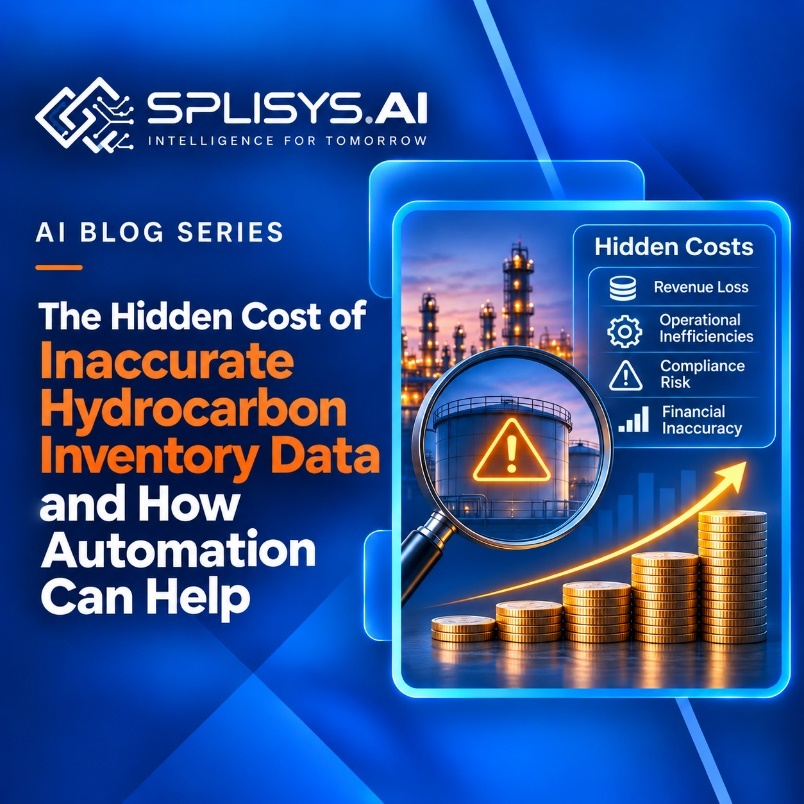
How confident are you in your hydrocarbon inventory data?
For Oil & Gas organizations, even relatively small inventory discrepancies can create significant operational challenges. When inventory records don’t accurately reflect physical inventory, the impact can extend beyond reconciliation teams to financial reporting, operational planning, and business decision-making.
The challenge isn’t always a lack of data.
It’s ensuring that the data across multiple systems, facilities, and transactions is accurate, consistent, and reliable.
As Energy operations become increasingly complex, automated hydrocarbon inventory reconciliation offers an opportunity to improve inventory data accuracy while reducing the manual effort required to identify inconsistencies.
Why Is Hydrocarbon Inventory Accuracy So Important?
Hydrocarbon inventory accuracy refers to how closely recorded inventory positions reflect actual physical inventory, accounting for receipts, shipments, transfers, measurements, adjustments, and other operational activities.
Accurate inventory information supports several critical business functions:
When inventory information is incomplete or inconsistent, these activities can become more difficult.
What Causes Hydrocarbon Inventory Data Inaccuracies?
Hydrocarbon inventory reconciliation involves bringing together information from multiple sources.
Common causes of inventory discrepancies include:
Measurement variances: Differences in measurement methods, calibration, temperature corrections, or recorded quantities can affect inventory comparisons.
Transaction timing differences: Physical product movements and corresponding system transactions may not occur or be recorded at exactly the same time.
Missing or incorrect transactions: Incomplete receipts, transfers, shipments, or adjustments can create differences between physical and book inventory.
Disconnected systems: Inventory information may exist across SAP, terminal management systems, measurement applications, and other operational platforms.
Manual data handling: Repeated extraction, spreadsheet manipulation, and manual comparisons can introduce errors or inconsistencies.
Individually, these issues may appear manageable.
Across hundreds of thousands of transactions and multiple facilities, however, they can create substantial reconciliation complexity.
How Can Automation Improve Hydrocarbon Inventory Accuracy?
Automation can improve hydrocarbon inventory accuracy by systematically validating data, comparing inventory records, applying predefined business rules, and identifying discrepancies requiring investigation.
Rather than depending entirely on employees to manually review information, organizations can introduce automated processes that help maintain greater consistency across reconciliation activities.
Inventory reconciliation begins with reliable information.
Automated validation can check records for missing fields, inconsistent values, duplicate transactions, and other conditions that may affect reconciliation accuracy.
Identifying these issues earlier helps prevent unreliable data from moving further through the reconciliation process.
Matching physical inventory measurements with corresponding transactional records can be time-consuming.
Automation can apply predefined matching rules to compare inventory positions, movements, and related records across relevant data sources.
This reduces repetitive manual comparisons and helps teams identify unmatched information more efficiently.
The longer an inventory discrepancy remains unidentified, the more difficult it may become to investigate.
Automated reconciliation can flag variances when relevant data becomes available, giving teams an opportunity to investigate issues before they accumulate.
Manual processes can vary depending on the individual performing the reconciliation.
Automation helps standardize how records are validated, matched, and evaluated against established business rules.
This consistency is particularly valuable for organizations operating across multiple facilities or business units.
Reliable inventory information is essential for operational decision-making.
By reducing repetitive manual activities and organizing reconciliation results, automation can help organizations gain clearer visibility into outstanding discrepancies and inventory positions.
Moving From Data Collection to Data Confidence
Having more inventory data doesn’t automatically mean having better inventory information.
The real value comes from ensuring that data is accurate, consistent, and actionable.
For Energy organizations, automated hydrocarbon inventory reconciliation can help establish a more reliable foundation for operational and financial decision-making.
And as inventory volumes and operational complexity continue to grow, that foundation becomes increasingly important.
At Splisys, we believe the next evolution of hydrocarbon inventory management is about more than collecting information.
It’s about turning complex inventory data into greater confidence, visibility, and operational control.
We’re bringing our SAP and Oil & Gas expertise together to help Energy organizations take that next step.
A smarter approach to hydrocarbon inventory reconciliation is coming. Stay tuned.
Ready to Improve Hydrocarbon Inventory Accuracy?
Connect with the Splisys team to explore how automation can help your organization reduce manual reconciliation activities, improve inventory data reliability, and extend the value of your SAP environment.
Frequently Asked Questions
What is hydrocarbon inventory accuracy?
Hydrocarbon inventory accuracy is the degree to which recorded inventory information reflects actual physical inventory, considering measurements, movements, transactions, and adjustments.
How does automation reduce hydrocarbon inventory errors?
Automation helps reduce errors by consistently validating data, comparing inventory records, identifying missing or inconsistent information, and flagging discrepancies for investigation.
Can SAP support automated hydrocarbon inventory reconciliation?
Yes. SAP environments can be complemented by specialized automation solutions that use relevant SAP and operational data to support inventory validation, matching, and reconciliation.
Does automated reconciliation eliminate inventory discrepancies?
No. Automation does not eliminate every discrepancy. It helps organizations identify and investigate inconsistencies more efficiently while improving the consistency of reconciliation processes.
Splisys uses the data submitted through this form to send you relevant marketing insights, blog updates, and learning resources. To learn more, read our Privacy Policy.