
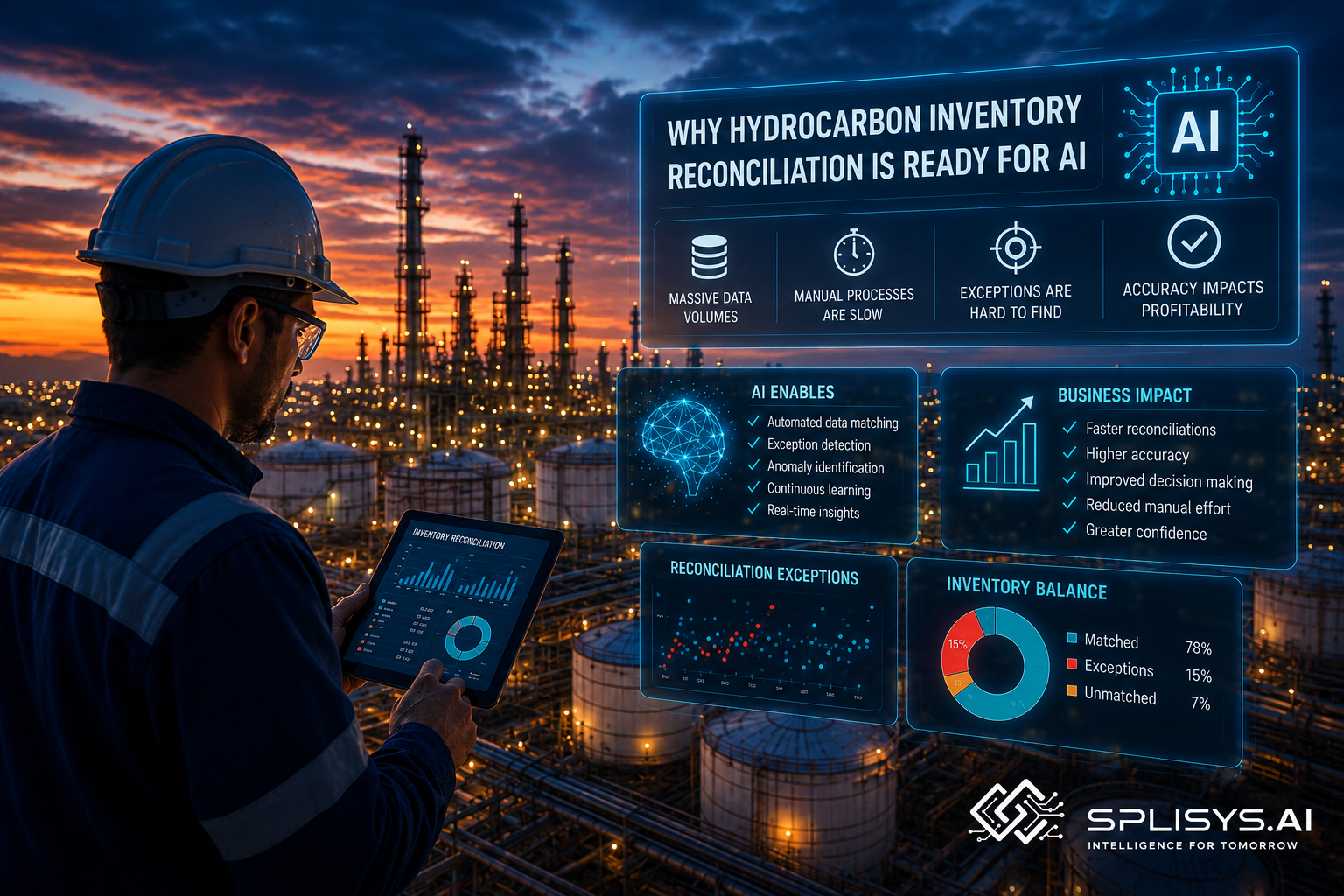
Hydrocarbon inventory reconciliation is one of the most critical—and often most labor-intensive—processes across Oil & Gas operations.
Refineries, terminals, pipelines, storage facilities, and other Energy operations continuously generate enormous volumes of inventory, movement, measurement, and transactional data. Determining whether those records accurately reflect physical inventory can require teams to compare information across SAP, operational systems, spreadsheets, and other data sources.
When something doesn’t reconcile, the real work begins.
Teams must determine whether an imbalance resulted from timing differences, incorrect transactions, measurement variances, missing information, operational events, or another exception.
What Is Hydrocarbon Inventory Reconciliation?
Hydrocarbon inventory reconciliation is the process of comparing physical and book inventory, product movements, measurements, and transactional records to identify and resolve discrepancies across Oil & Gas operations.
Accurate reconciliation helps organizations maintain confidence in inventory positions, support financial reporting, improve operational decision-making, and identify potential issues faster.
The challenge is that many reconciliation processes still rely heavily on manual analysis.
Why Traditional Reconciliation Is Difficult to Scale
The problem isn’t simply data volume. It’s complexity.
A single inventory position can be influenced by receipts, transfers, production, shipments, storage movements, measurement data, timing differences, and adjustments occurring across multiple locations and systems.
As operations grow, teams can spend increasing amounts of time searching for exceptions instead of resolving them.
That’s where AI can change the reconciliation model.
How Can AI Improve Inventory Reconciliation?
AI can continuously analyze inventory and transactional data to:
Instead of asking experienced employees to search through thousands of transactions looking for problems, AI can help identify where those employees should focus.
From Manual Reconciliation to Exception-Driven Reconciliation
The biggest opportunity may not be eliminating human involvement.
It’s making human involvement more valuable.
AI-powered reconciliation can automate routine matching and validation while directing experienced employees toward exceptions requiring operational judgment.
That creates a fundamentally different workflow:
Validate → Detect → Prioritize → Investigate → Resolve
Rather than spending the majority of a reconciliation cycle finding discrepancies, teams can spend more time resolving them.
The Future of Hydrocarbon Reconciliation
Energy companies already have enormous amounts of operational and enterprise data.
The next step is making that data more intelligent.
AI-powered hydrocarbon inventory reconciliation can help organizations move toward faster reconciliation cycles, greater inventory confidence, improved operational visibility, and more proactive exception management.
At Splisys, we’re applying our Energy, SAP, and AI expertise to help make that future possible.
Something new is coming from Splisys.AI.
For more information about how Splisys can help implement and aid in your AI strategy contact us:
From strategy to implementation, Splisys helps turn Al opportunities into practical, scalable business solutions.
Frequently Asked Questions
Can AI automate hydrocarbon inventory reconciliation?
Yes. AI can automate significant portions of data validation, matching, anomaly detection, and exception identification while allowing business users to investigate and resolve exceptions requiring human judgment.
Can AI work with existing SAP environments?
Yes. AI-powered reconciliation solutions can complement SAP environments by analyzing relevant enterprise and operational data without requiring organizations to replace their core ERP platform.
What is exception-driven reconciliation?
Exception-driven reconciliation automatically processes records that meet defined reconciliation criteria while directing users toward discrepancies, anomalies, or imbalances requiring investigation.
Splisys uses the data submitted through this form to send you relevant marketing insights, blog updates, and learning resources. To learn more, read our Privacy Policy.
